Leading when the load arrives
Explore the gap between an organisation chart and its real support structure. What happens when responsibility concentrates? When should a team ask for help? How can it notice dependencies before they become a problem? Designed for leadership events and executive team gatherings.
The cap de colla perspective
Making decisions without doing everything yourself, listening to signals and matching ambition to readiness. Castells provide a starting point for discussing authority, trust and coordination. The talk distinguishes the tradition from our interpretation for the workplace.
From the experience to Monday morning
How to turn a shared activity into a useful question and a reviewable agreement. This theme is relevant to people designing team events, learning and development.
Start with the conversation your audience needs
A keynote can open a leadership gathering, provide context for a team day or leave a question for the work that follows. To choose the approach, we ask the organiser who will be in the room and what discussion they want to make possible. A newly formed committee has different needs from leaders who have worked together for years. We want to understand their shared language, the decision occupying them and how much room there will be for questions. With that context, we propose a central thread and a closing format, rather than a catalogue of messages competing for the audience’s attention.
From a story to a working question
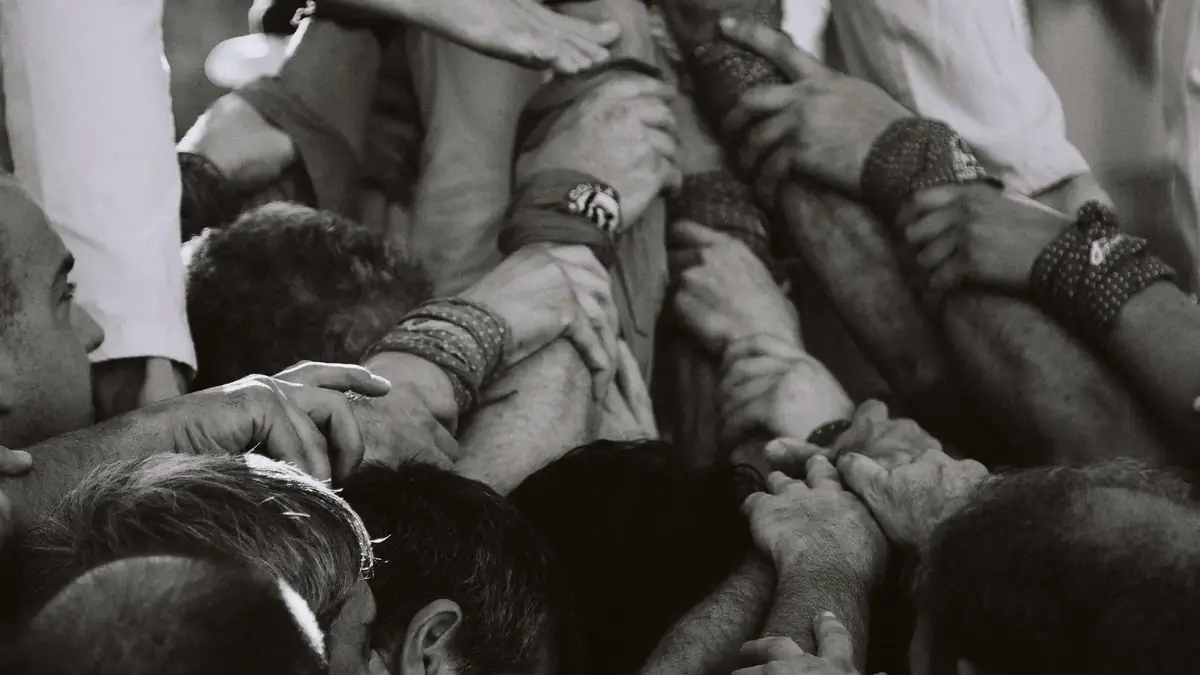
The proposed sequence starts with a situation from castells, explains what it allows us to notice and opens a question about the organisation. We distinguish the tradition itself from our interpretation for teams at work. The pinya offers a way to discuss support; the tronc, coordination between responsibilities; the cap de colla perspective, decisions that make collective work possible. A talk can close with a facilitated discussion or with questions the team can explore independently. We agree that closing format before the event so the organiser can connect it to the rest of the day and to the work planned afterwards.
A question to take into Monday
As an illustration, a talk about invisible support could close with this question: “Who needs to be available for you to deliver what you have promised?” Each person can consider a recent situation, identify a dependency and discuss it with the person providing that support. The question aims to open a concrete conversation, not to assess individuals or attribute an outcome to the keynote. If the organisation wants to turn that reflection into shared agreements, we can discuss a subsequent working session. The proposal will clearly distinguish the talk’s content, discussion time and any additional facilitation requested by the organiser.
What we need to prepare a proposal
Does the keynote include building a castell? Not by default: a talk and a physical experience are different formats and must be specified in the brief. Can it be part of an offsite? Yes, we can discuss how it connects with the committee’s working question. Can it be recorded or streamed? This needs to be agreed in advance, including subsequent use of the material. What determines the quote? Scope, preparation, duration, travel and additional participation. Send us the date, location, audience, language and purpose. If some details are still open, explain what is decided and what you need to work out, and we will start there.
Preparing the event with the organiser
Once the approach is agreed, we clarify technical requirements, speaker introductions and the materials the organiser needs. We agree who will coordinate details on the day and how audience questions will be collected. The organiser checks that the content matches what was announced and the available time.